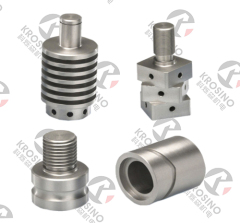
Suzhou Krosino Mechatronic Technology Co., Ltd. delivers high-end manufacturing solutions through our specialized, professional CNC Aluminum Service. Engineered to optimize strength-to-weight ratios and strict structural tolerances, our Customized Aluminum Parts fulfill the rigid accuracy expectations of global OEM procurement teams. By synchronizing advanced milling paths with complex rotational setups, we manage material stability across thin-walled geometries, producing turnkey mechanical spare parts that seamlessly integrate into high-speed automation systems and industrial machinery layouts.
Eliminating cumulative fixturing errors is vital when engineering high-precision aluminum components with complex features. Our facility leverages advanced turn-mill centers to execute multi-surface machining tasks in a single operational sequence. This approach guarantees flawless perpendicularity and concentricity between turned diameters, milled pockets, and drilled patterns, reducing processing bottlenecks and preserving extreme positional accuracies across medium-to-large production volumes.
Our rigid multi-axis machining setups optimize chip evacuation and stepover tracking for deep pockets and intricate surface contours. This specialized setup ensures precise wall thicknesses and zero distortion on complex lightweight structural housings, brackets, and panels through our high-capacity CNC Milling Services.
Utilizing fine-tuned indexable inserts and stable spindle configurations, we control rotational tolerances down to micron levels. This enables fast cycle times and a pristine surface topology for stepped shafts, precision pins, and threaded collars across our full range of custom CNC Lathe Parts.
| Parameter | Technical Standard / Capacity |
|---|---|
| Core Machining Scope | Full-scale CNC Machining, turning, milling, thread-milling, and integrated multi-axis profiling. |
| Dimensional Tolerance | Linear features held reliably to ±0.01mm; critical internal bores and bearing journal seating limits kept strictly down to ±0.005mm. |
| Surface Roughness | As-machined finishes achieving Ra 0.8–1.6 μm; specialized turning or polishing paths can achieve mirror-like finishes down to Ra 0.4 μm. |
| Material Specifications | Premium Aluminum Alloys (6061-T6, 7075-T6, 2024, 5052), Structural Stainless Steel (SUS303, SUS304, SUS316), and Engineering Polymers (POM/Acetal). |
| Surface Treatments | Clear/Color Anodizing (Type II), Hardcoat Anodizing (Type III), Sandblasting (bead blast), Chemical Film, Passivation, and specialized Parts Surface Finishing. |
| Production Scalability | B2B operations engineered for rapid engineering validation through our Rapid Prototyping Service before transitioning into high-volume batch delivery. |
Our customized aluminum components provide reliable long-term service across demanding, high-wear industrial environments worldwide. Backed by material test certifications and comprehensive coordinate measuring machine (CMM) inspections, we guarantee absolute compliance with your technical drawings.
Q1: How do you prevent thread stripping in customized aluminum components used in high-stress applications?
Aluminum alloys have a lower shear strength compared to steels, making native threads vulnerable to stripping under extreme fastening torques. We resolve this by recommending and executing precise thread-milling for optimal thread profile accuracy. For high-cycle or heavy load couplings, we prepare precision counterbores engineered for helical wire inserts (such as Helicoils), which distribute load stresses evenly and significantly extend the thread life of the component.
Q2: What parameters dictate the selection between Type II and Type III Anodizing for aluminum turning-milling parts?
The selection depends entirely on the working environment of your part. Type II Anodizing creates a thin oxide layer (typically 5–25 μm) that provides excellent atmospheric corrosion protection and a wide variety of aesthetic color options. Type III Hardcoat Anodizing is processed at colder temperatures, forming a thick, dense oxide coating (50 μm or greater). Type III is selected strictly for parts facing extreme mechanical wear, sliding friction, or harsh chemical environments, raising surface hardness up to 60 HRC.

 Contact Us