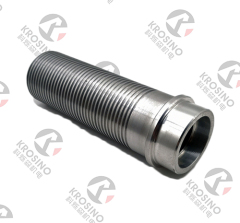
Suzhou Krosino Mechatronic Technology Co., Ltd. delivers high-performance mechanical components engineered specifically for automated packaging lines through our specialized CNC Lathe Turning Services. Designed to handle high cyclic loads, precise timing sequences, and strict dimensional tolerances, our aluminum Packing Machine Threaded Shaft Parts meet the demanding accuracy requirements of global OEM procurement teams. By matching multi-axis precision turning with rigorous thread-profile validation, we eliminate axial backlash and geometric runout, ensuring smooth power transmission and long-term service life in industrial packaging environments.
Manufacturing threaded shafts from high-grade aluminum alloys requires careful thermal control and rigid tool paths to prevent pitch errors and material deformation. Our turning facility utilizes state-of-the-art live tooling and synchronized sub-spindles to execute precision single-point threading, multi-start lead screws, and keyway indexing in a single production setup. This optimized method ensures perfect coaxiality between bearing journals and threaded sections, eliminating structural vibration and premature wear in high-speed packaging machinery.
Our advanced lathes maintain tight pitch tolerances on customized external threads and lead structures. By utilizing indexable tooling and continuous CNC tool-wear monitoring, we achieve sharp, burr-free thread profiles that prevent binding on heavy-duty CNC Machining Parts.
Leveraging premium grades such as AL6061-T6 and AL7075-T6, we combine high cutting speeds with specialized chip-breaker geometries. This produces a flawless surface finish and ensures high geometric stability on lightweight structural components using our dedicated CNC Aluminum Service.
| Parameter | Technical Standard / Capability |
|---|---|
| Core Machining Scope | Precision CNC Machining, single-point threading, live-tool keyway milling, axial drilling, and turn-mill synchronization. |
| Dimensional Tolerance | Standard linear features held to ±0.01mm; critical bearing journals and thread pitch diameters controlled down to ±0.005mm. |
| Geometric Runout | Total indicator runout (TIR) and concentricity strictly maintained within 0.01mm along the entire length of the shaft. |
| Surface Roughness | As-turned finish reaching Ra 0.8 μm; specialized polishing paths can achieve smooth sealing surfaces down to Ra 0.4 μm. |
| Material Spectrum | High-strength Aluminum Alloys (6061, 7075), Industrial Stainless Steel (SUS303, SUS304, SUS316), and low-friction polymers like POM (Acetal). |
| Surface Finishing | Type II Clear/Color Anodizing, Type III Hardcoat Anodizing (for high-wear packaging contact zones), Bead Blasting, and comprehensive Parts Surface Finishing. |
| Production Workflow | Engineered for seamless transition from initial prototyping via our Rapid Prototyping Service to standardized OEM batch orders. |
Our precision aluminum threaded shafts operate reliably within high-speed packaging, sorting, and bottling lines worldwide. Every batch is backed by comprehensive material certificates and full coordinate measuring machine (CMM) reports, ensuring absolute compliance with your technical drawings.
Q1: Why is controlling concentricity and runout critical for threaded shafts used in automated packaging lines?
In high-speed packaging equipment, any geometric deviation or runout along a threaded shaft creates asymmetric forces during rotation. This leads to cyclic vibration, thread binding, and accelerated wear on surrounding bearings and seals. We control runout to within ±0.01mm by separating roughing and finishing paths on our CNC lathes, utilizing high-precision live centers to eliminate structural deflection and maintain strict tracking accuracy.
Q2: What surface treatment is best suited for aluminum threaded shaft parts subject to continuous friction?
For aluminum parts facing constant mechanical friction or sliding contact (such as mating threads or bearing surfaces), we strongly advocate for Type III Hardcoat Anodizing. This process forms a dense, integrated aluminum oxide layer extending 50 μm or deeper into the material, raising surface hardness up to 60 HRC. This treatment drastically increases abrasion resistance, prevents material galling, and significantly extends the service life of lightweight components in demanding automated systems.

 Contact Us